The Orell Language Laboratory is a comprehensive digital language laboratory system designed to transform communication learning in schools, colleges, universities, and professional training institutions. Built on modern pedagogy and advanced learning technologies, the Orell language laboratory system provides a structured environment for developing listening, speaking, reading, and writing skills in English and multiple global languages

Trusted by 10,000+ institutions across 100 countries

Premium Schools

Colleges & Universities

Training Centres & Corporates

Government Projects Worldwide
The Orell language laboratory software enables institutions to implement standardized communication training programs across departments while ensuring measurable learning outcomes and transparent performance tracking. With its scalable architecture and flexible deployment models, the system can be used in schools, colleges, universities, language institutes, and professional training centers.

By combining technology-driven learning with structured pedagogy, the Orell language laboratory system for colleges and schools ensures that students develop communication skills that meet global academic and professional standards.

The Orell digital language laboratory is built on a flexible architecture that supports various institutional environments. Whether deployed in a physical laboratory, integrated with campus networks, or delivered as an online language laboratory, the system ensures seamless communication learning experiences. The architecture of the Orell multimedia language laboratory includes student workstations, instructor control consoles, centralized servers, and cloud-based learning modules. This infrastructure allows teachers to monitor classroom activities, assign exercises, conduct evaluations, and manage learning sessions efficiently. The system also supports AI language laboratory capabilities, enabling automated speech analysis, pronunciation evaluation, and performance tracking.
Key components of the Orell language laboratory system include:
Through this integrated architecture, the Orell digital language laboratory ensures that institutions can deliver consistent and scalable communication training programs.
One of the core strengths of the Orell language
laboratory software is its alignment with the Common European Framework of Reference for
Languages (CEFR). This internationally recognized standard defines language proficiency
levels ranging from beginner to advanced communication mastery.
The Orell language
laboratory system follows a progressive learning model that moves students through the
following levels:
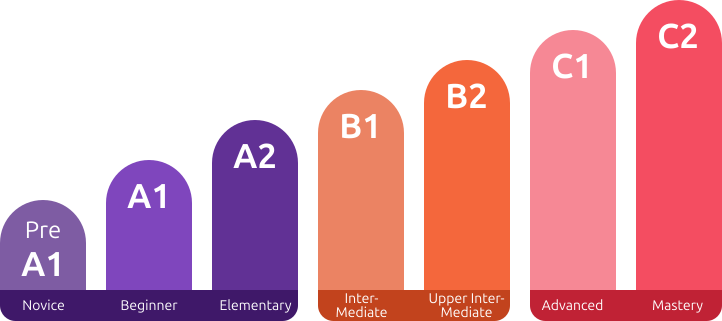
Each level within the digital language laboratory includes structured learning modules, interactive exercises, pronunciation training, listening comprehension tasks, and writing activities. This structured progression ensures that students gradually build communication skills while achieving internationally recognized proficiency standards.
Educational institutions that adopt a language laboratory system for colleges gain several advantages:
Communication has become a foundational skill in modern education systems. Students are expected not only to understand academic subjects but also to express ideas clearly, collaborate effectively, and communicate confidently in global environments. As a result, educational institutions increasingly recognize the importance of implementing a language laboratory system that supports structured language learning. A digital language laboratory provides a controlled learning environment where students can practice speaking, listening, and comprehension skills through guided exercises. Unlike traditional classroom methods, the multimedia language laboratory integrates audio, video, and interactive activities to create immersive language learning experiences. For schools and colleges, implementing a language laboratory for English learning ensures that students develop communication proficiency from an early stage. This is especially important in regions where English is a second language but serves as the primary medium for higher education and professional communication. The Orell online language laboratory addresses these challenges by providing a scalable and structured learning ecosystem. Students can practice pronunciation, participate in group discussions, complete interactive exercises, and receive instant feedback on their communication performance.
The Orell multimedia language laboratory uses advanced multimedia technologies to make language learning interactive and engaging. Instead of relying solely on textbooks and lectures, students participate in immersive communication exercises that simulate real-life scenarios. The digital language laboratory integrates audio recordings, video demonstrations, speech analysis tools, and interactive assignments that encourage students to actively practice communication skills.
Multimedia learning features include:
Through these multimedia capabilities, the Orell language laboratory system for colleges creates a dynamic learning environment that enhances student engagement and retention.

One of the most advanced features of the Orell AI language laboratory is its intelligent speech analysis technology. This system evaluates pronunciation accuracy, speech clarity, intonation, and fluency in real time. Students can record their speech, compare it with standard pronunciation models, and receive automated feedback on areas that require improvement.
The AI language laboratory system supports:
By incorporating artificial intelligence into communication training, the Orell digital language laboratory ensures that students receive objective and consistent feedback.

The Orell language laboratory system includes a wide range of communication development modules that cover academic, social, and professional communication scenarios. Each module within the multimedia language laboratory is designed to strengthen specific language competencies.
Communication modules include:
Through these modules, the language laboratory for schools and colleges ensures that students develop practical communication skills required in real-life situations.
Benefits for schools include:
By introducing the language laboratory system at the school level, institutions can ensure that students develop strong communication skills that support their future academic success.
The Orell English language laboratory for schools helps young learners build strong communication foundations from early stages of education. Students in school environments often struggle with pronunciation, listening comprehension, and confidence in speaking English. A digital language laboratory for schools provides structured learning modules that make communication practice interactive and engaging.
Key benefits for colleges include:
Through these modules, the Orell language laboratory software prepares students for the communication challenges of modern workplaces.
The Orell language laboratory system for colleges focuses on advanced communication skills required for higher education and professional careers. College students must prepare for presentations, group discussions, interviews, and workplace communication. The digital language laboratory provides training modules that help students develop professional communication competencies.
The Orell online language laboratory enables institutions to deliver communication training beyond physical classrooms. Students can access learning modules remotely, practice communication exercises, and participate in virtual sessions with instructors.
This flexibility ensures that institutions can provide continuous communication training regardless of location.
Online language laboratory capabilities include:
The Orell language laboratory system includes advanced classroom management tools that allow instructors to supervise and guide student learning effectively. Teachers can monitor individual student activities, conduct group communication exercises, and provide real-time feedback during sessions.
These features ensure structured and disciplined learning within the digital language laboratory environment.
Assessment capabilities include:
Institutional reporting tools provide administrators with insights into student performance, departmental outcomes, and overall communication development trends.
The Orell language laboratory software includes comprehensive evaluation tools that measure student communication performance across multiple parameters.
Key benefits include:
Educational institutions implementing the Orell digital language laboratory gain significant academic and operational advantages.
The Orell language laboratory system represents a modern approach to communication learning that combines technology, pedagogy, and analytics. By adopting the Orell digital language laboratory, institutions can transform traditional language teaching methods into dynamic and measurable learning experiences. Whether deployed as a multimedia language laboratory, online language laboratory, or AI language laboratory, the system provides a scalable and future-ready communication learning environment.



 1800-890-8040
 +91 93888 14000